
Here's a scenario you might find familiar. You're meeting a new prospect whose books appear "mostly fine." But here's what you don't know: the last bookkeeper left in spring, the owner has been categorizing transactions on weekends, and they want monthly service to start next week.
You then open the file, and see that two card accounts haven't been reconciled since March. Uncategorized Expense holds five figures. Opening Balance Equity has a balance that looks impossible to explain.
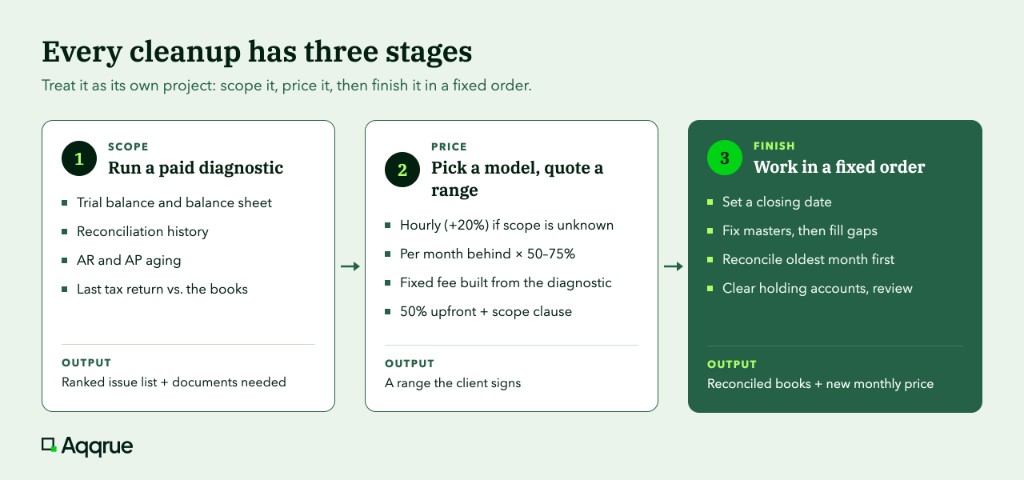
The good news is that this is normal. Clients rarely switch bookkeepers when everything is going well, so almost every new client arrives with some bookkeeping cleanup (or catch-up) attached. Treat it as its own project: scope, price, finish.
Signs that a file needs cleanup
A first pass through QuickBooks Online usually shows it. Look for:
- Bank or card accounts with no reconciliation in the last two or three months, unless they have explicitly stated reporting cycles that are different
- Balances in Uncategorized Income, Uncategorized Expense or Ask My Accountant
- Undeposited Funds that keeps growing
- Negative balances where there shouldn't be any, like a checking account or inventory
- Duplicate vendors and customers ("Amazon", "Amazon.com", "AMZN Mktp")
- An Opening Balance Equity account that was never cleared
- AR or AP aging that doesn't match what the client says they're owed or owe
The more of these you find, the bigger the job.
Step 1. Scope: read the data before you quote
Clients may not know the full extent of what's wrong with their books. If they knew, the books wouldn't be wrong, so the quote has to come from the file.
A diagnostic answers four questions:
- How much activity is there? Transactions per month, and whether volume is steady or spiky.
- How complex is each transaction? Lines per transaction, journal entries, and accounts like Undeposited Funds that need matching.
- When was each account last reconciled? Every bank, card and loan account.
- Do AR, AP and last year's tax return tie to the books? If not, the cleanup may start further back than the client thinks.
By hand, that means pulling reports and reading them account by account.
What the diagnostic looks like in Aqqrue
In Aqqrue, the diagnostic starts with a request in plain English. Take Craig's Design and Landscaping Services, the sample company in QuickBooks Online. Aqqrue was asked to go through the client's transaction volume and trends, then answer three questions:
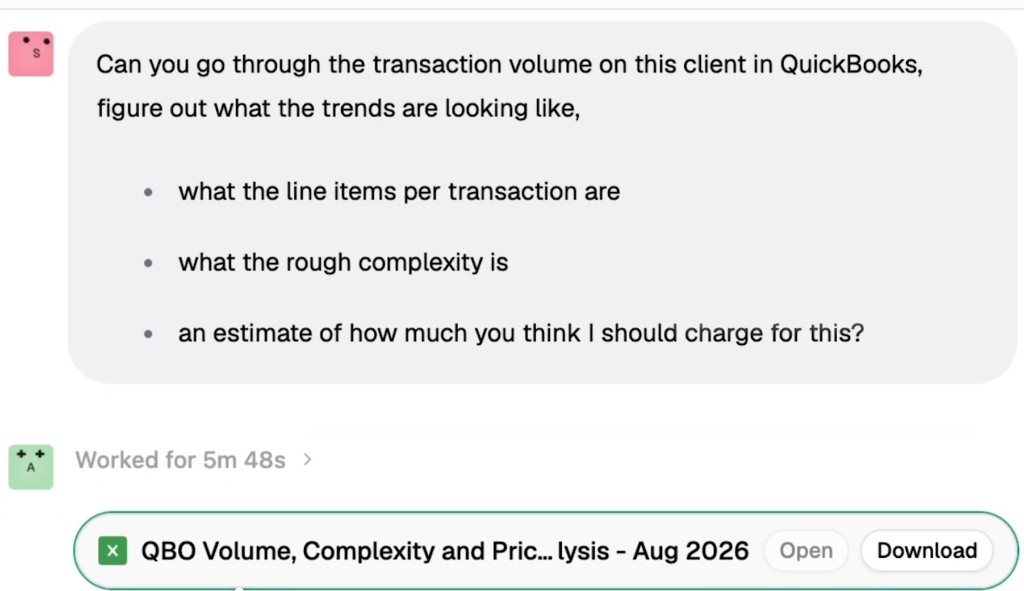
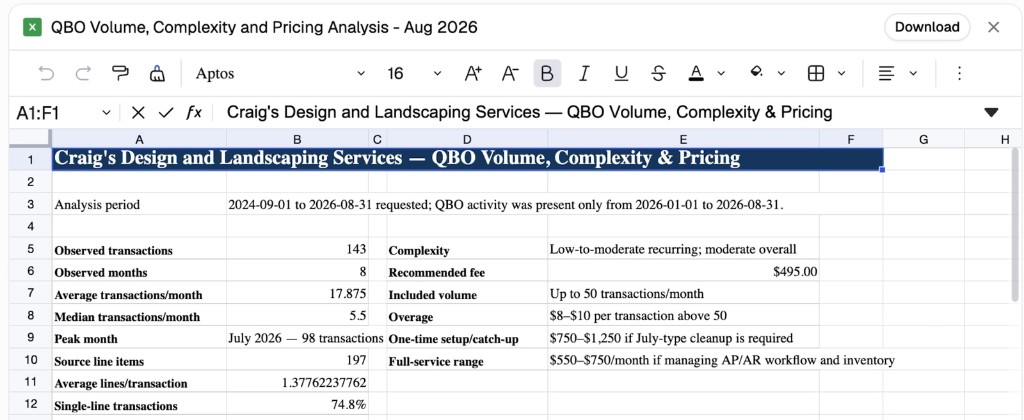
Aqqrue worked through the QuickBooks data for under six minutes and returned these numbers:
| Metric | Result |
|---|---|
| Posted transactions, Jan to Aug 2026 | 143 |
| Average per month | 17.9 |
| Median per month | 5.5 |
| Peak month | July, 98 transactions |
| Average lines per transaction | 1.38 |
| Single-line transactions | 75% |
| Average journal-entry lines | 2.63 |
The gap between the average and the median is the finding that matters. A typical month has about five transactions. July had 98 because it included opening balances, inventory setup and other catch-up work. Quote from the average and you'd overprice monthly work and miss that July was a cleanup.
Aqqrue also rated the file's complexity as low to moderate and showed why:
- What adds work: matching invoices and bills to payments, Jobber deposits running through Undeposited Funds, and occasional multi-line journal entries.
- What keeps it simple: almost no class tracking, mostly single-line expenses and bills, and low recurring volume.
- What it couldn't see: QuickBooks attachments weren't available, so receipt collection should be priced separately.
All of it lands in a workbook you can download and keep with the engagement file.
Step 2. Price: pick a model that fits what you found
| Model | How it works | Use it when |
|---|---|---|
| Hourly plus 20% | Estimated hours × your rate, plus about 20% for onboarding and client back-and-forth | You can't see the scope yet, such as when statements are missing |
| Per month behind | Your monthly fee × months to catch up, quoted at 50% to 75% of the total | The books are behind but the work is routine |
| Fixed fee | Price each issue on the diagnostic list and add them up | You have a full issue list |
A 20% buffer is one practical way to account for onboarding and client back-and-forth. The per-month method is quicker when the work is relatively routine, while fixed-fee pricing is easier to defend when you have a detailed issue list.
Here's how the first two compare in one file. The numbers are illustrative: you'd charge $600 a month, and the books are 10 months behind.
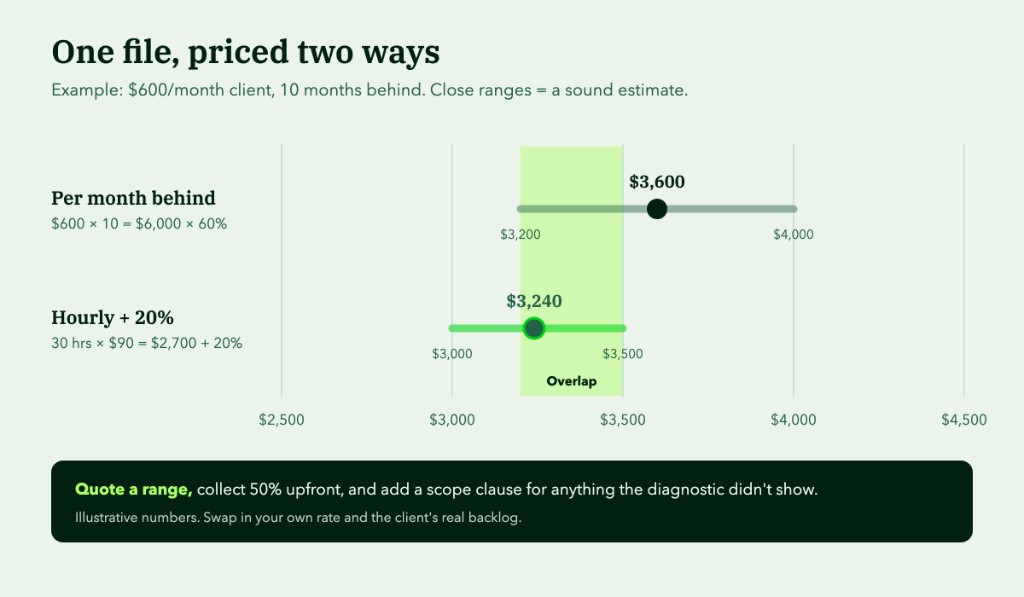
| Model | Calculation | Quote |
|---|---|---|
| Per month behind | $600 × 10 = $6,000. At 60%, that's $3,600. | $3,200 to $4,000 |
| Hourly plus 20% | 30 hours at $90 is $2,700. Add 20% and you're at $3,240. | $3,000 to $3,500 |
If the two land close together, your estimate is probably sound. If they're far apart, go back to the diagnostic.
How Aqqrue priced the sample client
Aqqrue's pricing recommendation for Craig's Design and Landscaping keeps the cleanup apart from the monthly fee:
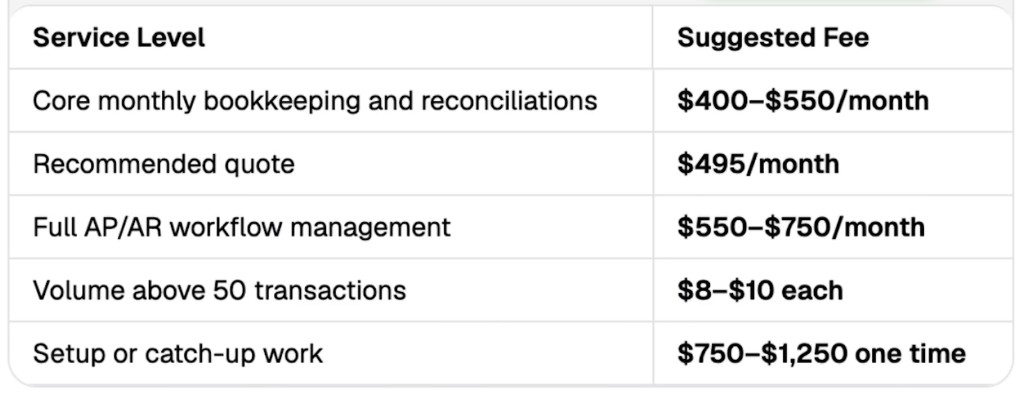
| What you're pricing | Fee |
|---|---|
| Monthly service, up to 50 transactions | $495 a month, covering three account reconciliations, the monthly close and basic financial reporting |
| Each transaction above 50 | $8 to $10 |
| Another July-sized month, or opening-balance or inventory cleanup | $750 to $1,250, priced as separate project work |
That split is the point. The monthly fee comes from a normal month, and the cleanup is priced as a project. Your own rates and market still set the final number.
Whichever model you use, three habits protect your margin:
- Quote a range, not a number. It leaves room for what the diagnostic couldn't see.
- Take at least 50% upfront. Collect the rest before final reports.
- Add a scope adjustment clause. Issues outside the diagnostic, like an account the client didn't disclose, are billed separately.
Step 3. Finish: the cleanup sequence
Without a fixed order, you fix March, then find a January problem that changes March again. Work in this sequence:
- Agree on a cutoff date with the client at the start of the cleanup. Once a period has been reconciled and reviewed, consider setting or updating QBO's closing date to protect the completed books from unintended changes.
- Fix the masters first. Clean up the chart of accounts and merge duplicate vendors and customers before you touch transactions.
- Fill bank and card gaps. Import missing history from statements. Here's how to rebuild missing credit card transactions from statements.
- Reconcile every account, oldest month first. Each finished month becomes the starting point for the next.
- Review holding accounts and resolve unexplained balances. Reclassify transactions in Uncategorized Income and Expense, investigate outstanding items in Ask My Accountant, match Undeposited Funds against actual deposits, and investigate Opening Balance Equity. Don't force balances to zero without understanding their underlying transactions.
- Review the final period as you would any month-end close. Our month-end review checklist is the sign-off.
Aqqrue can take the first pass at this work too: it clears holding accounts, cleans up masters and flags duplicates. Nothing posts to QBO until you've reviewed it.
Hand off to monthly, and re-price
The cleanup is done when all agreed periods have been reconciled, outstanding exceptions have been reviewed or documented, and the client has signed off on the final reports. Before monthly service starts, re-price using the hours you measured, not the sales-call estimate. Aqqrue carries what it learned about the client during the cleanup into monthly work, so you don't start from zero.
Once the numbers are right, you can turn clean books into advisory: a cash forecast, a few KPIs and a monthly note.