
This guide is for small firm owners who are hiring or training bookkeepers, and for staff who want a credential that clients and employers recognize. Search for a bookkeeping certification online and you'll find hundreds of courses, many of which overlap or teach skills your team won't use in QuickBooks Online. Below, we compare six well-known certifications, suggest a training path for a new hire, and cover what no course will teach them.
Certificate, certification or designation? Check which one you're looking at
"Certified" gets used loosely in bookkeeping, and the difference matters when you hire. A certificate of course completion shows someone finished a course. A professional designation shows they passed the issuing body's exams, proved work experience and keep up continuing education.
| Credential type | What it proves | What it doesn't prove | Examples in this guide |
|---|---|---|---|
| Certificate of course completion | The person finished a set of courses | That they've done the work in real client books | Intuit Academy Bookkeeping Professional Certificate (Coursera) |
| Exam-based skills or software certification | They passed an online exam on a topic or a product | Work experience, or skill outside that product | Intuit Bookkeeping Certification, QuickBooks Online Certification Levels 1 and 2 |
| Professional designation | They passed the issuing body's exams, documented work experience, agreed to an ethics code and keep up continuing education | That they know your clients or your firm's process | AIPB Certified Bookkeeper (CB), NACPB Certified Public Bookkeeper (CPB) |
NACPB calls the CPB a license, but it's a private credential, not a state license. Bookkeepers in the US don't need a state license to work.
Which one should I choose?
If you only need a quick answer, start from the person's experience and the work they'll do.
| If the person is... | Start with |
|---|---|
| New to bookkeeping, with no accounting background | Intuit Academy Bookkeeping Professional Certificate |
| A new hire at a firm already in the ProAdvisor program | Intuit Bookkeeping Certification |
| Working in client QuickBooks Online files every day | QuickBooks Online Certification Level 1, then Level 2 |
| An experienced bookkeeper who wants a recognized title | AIPB Certified Bookkeeper |
| A bookkeeper who wants a license-style credential with yearly CPE | NACPB Certified Public Bookkeeper |
For most staff at a QBO firm, the practical order is fundamentals first, then QuickBooks Online Level 1.
Six online bookkeeping certifications and credentials compared
These six cover most of what a US firm working in QuickBooks Online would consider, but they aren't the same kind of credential. Two teach bookkeeping fundamentals, two prove QuickBooks Online skills, and only the AIPB and NACPB credentials require verified work experience. The Type column shows which is which, so weigh them accordingly. Prices and formats change, so confirm the current details on each provider's site before you enroll anyone.
| Certification | Type |
|---|---|
| Intuit Academy Bookkeeping Professional Certificate | Professional certificate (multi-course program) |
| Intuit Bookkeeping Certification | Bookkeeping certification (training plus exam) |
| QuickBooks Online Certification Level 1 | Software certification (QuickBooks Online) |
| QuickBooks Online Certification Level 2 | Software certification (advanced QuickBooks Online) |
| Certified Bookkeeper (CB) | Professional designation |
| Certified Public Bookkeeper (CPB) | Professional license/credential |
Cost, time and upkeep at a glance
US prices as listed by each provider in November 2026. Fees change, so check the official site before you enroll anyone.
| Credential | Total cost | Time to earn | Continuing education to keep it | Official source |
|---|---|---|---|---|
| Intuit Academy Bookkeeping Professional Certificate | $39 a month on Coursera, about $160 at Coursera's four-month estimate | About 54 hours of content, or roughly four months at under four hours a week | None | Coursera |
| Intuit Bookkeeping Certification | Free | Self-paced; Intuit doesn't publish an hour estimate | None stated | Intuit training and certification |
| QuickBooks Online Certification Level 1 | Free with ProAdvisor access | About 7.5 hours of training | A recertification exam every year, due by June 30 | Intuit ProAdvisor FAQ |
| QuickBooks Online Certification Level 2 | Free with ProAdvisor access | About 6.5 hours of training, at least 90 days after Level 1 | The same yearly recertification | Intuit ProAdvisor FAQ |
| AIPB Certified Bookkeeper (CB) | Around $1,495 for the guided online prep course, including registration, six workbooks and Prometric exam fees. Self-study starts at $314 for the workbook set, plus registration and exam fees. | A 99-hour prep course, plus two years of full-time or 3,000 hours of part-time experience | 60 CPE hours every three years | AIPB |
| NACPB Certified Public Bookkeeper (CPB) | $100 license application and a $25 yearly renewal, plus fees for four courses and exams, sold separately or as a bundle | Four courses and exams, plus one year of supervised bookkeeping experience | 24 CPE hours every year, starting the year after licensing | NACPB |
Here's what stands out about each one.
- Intuit Academy Bookkeeping Professional Certificate
This is a four-course series on Coursera aimed at beginners, with no degree or experience required. It covers basic bookkeeping concepts, the accounting cycle and reading financial statements. It's included with a Coursera Plus subscription, which makes it an easy first assignment for a new hire.
- Intuit Bookkeeping Certification
Intuit added a free, self-paced bookkeeping certification inside its ProAdvisor Academy to teach accounting fundamentals to new talent. If your firm is already in the ProAdvisor program, this is the lowest-cost place to start. You'll find it through Intuit's training and certification hub.
- QuickBooks Online Certification Levels 1 and 2
These are the certifications most firm owners mean when they call a hire QuickBooks certified. Intuit's ProAdvisor certification FAQ says you pass Level 1 first, and it suggests waiting at least 90 days before Level 2. QuickBooks Online certifications require annual recertification, so check Intuit's current training portal for the latest recertification window and requirements. Intuit's NASBA sponsor number is 103311 for CPE purposes, but whether a particular course qualifies for CPE credit depends on the course and the requirements of the relevant state board.
Note that QuickBooks Online Accountant is being replaced by Intuit Accountant Suite on December 31, 2026, so training access is moving there.
- AIPB Certified Bookkeeper
AIPB's CB is a national credential for working bookkeepers, not a beginner course. To earn it, AIPB requires passing a four-part exam and signing a code of ethics. You also need two years of full-time experience, or 3,000 hours of part-time or freelance work. You can meet the experience requirement before or after the exam, within three years of passing.
- NACPB Certified Public Bookkeeper
NACPB's CPB is set up as a license, with exams, documented experience, a code of conduct and annual continuing education. It suits bookkeepers who want a title that signals ongoing education to clients. NACPB's CPB steps page lists the current requirements and fees.
What to assess when hiring a bookkeeper, beyond certifications
A credential tells you what someone studied, not how they work in a client's books. Before you hire, test the skills your reviewers would otherwise end up fixing.
| What to assess | How to test it | What a good answer looks like |
|---|---|---|
| Hands-on QuickBooks Online work | A short, paid test in QBO's sample company: categorize 20 bank transactions and reconcile one month | Picks sensible accounts and flags what they're unsure of instead of guessing |
| Reconciliation judgment | Hand them a statement with a planted difference | Checks the beginning balance first, then traces in both directions |
| Review habits | Give them a draft P&L with three planted errors | Finds the errors and explains why each would matter to the client |
| Client communication | Ask them to draft an email requesting missing receipts | Clear, specific and polite, with a date to reply by |
| Process discipline | Ask how they keep track of each client's recurring quirks | Relies on checklists and client notes, not memory |
| Data security | Ask how they handle client logins and documents | Uses MFA, never shares logins and keeps client data out of personal AI accounts |
| Comfort with tools | Ask which bank-feed, receipt and AI tools they've used | Happy to review prepared work, not just key it in |
References help too. Ask a former manager how often the candidate's work came back with review notes, and what those notes were about.
A training path for a new hire
A certificate on its own won't make someone ready to close a client's month. The path below mixes formal courses with supervised work, so a new hire builds skills in the order they'll use them.
- Month 1: Assign the Intuit Academy certificate or the Intuit Bookkeeping Certification, depending on whether the hire has any accounting background.
- Month 2: Have them complete QuickBooks Online Certification Level 1, then shadow a senior team member on two or three client files.
- Months 3 to 6: Let them prepare reconciliations and categorization for a few simple clients, with every file reviewed before it's closed. Our guide to QBO credit card reconciliation makes a good first exercise.
- After six months: Consider QuickBooks Online Level 2 once the hire is comfortable with more complex client work. Treat AIPB or NACPB as longer-term professional development goals, and confirm each organization's experience and education requirements before enrolling.
It also helps to track which clients each new hire works on, so their supervised hours are documented for a future CB or CPB application.
What no certification course will teach
Certifications teach accounting fundamentals. Your firm's SOPs teach bookkeepers how to handle each client's books consistently. A new hire needs both, but only the second one is specific to your firm.
Courses teach general rules, but your clients teach the exceptions, and that's where most review notes come from. A new bookkeeper won't learn from any course that one client pays the owner's car loan from the business account. Nor will a course tell them that another client books revenue from a sales report each month.
The fix is a written internal process. Start with a month-end review checklist for your staff accountants and a month-end close checklist for the steps around it. Then add a short notes page for each client with their recurring quirks, and use our bookkeeping checklist for new clients to build it when a client joins. Pair every new hire with a reviewer for their first few closes, and ask them to update the client notes when they spot something new.
How Aqqrue helps new bookkeepers ramp up faster
Written SOPs only help if every bookkeeper follows them the same way, for every client, every month. That's the part of training Aqqrue is built to support.
Aqqrue is an AI work studio for accountants and bookkeepers in QuickBooks Online. It prepares bank and credit card reconciliations, journal entries, accruals, closes, book reviews and cleanups across your client files. Nothing posts to QuickBooks Online until someone on your team reviews and approves it.
Your firm's SOPs and client notes live in Aqqrue's knowledge base, so each client's quirks are written down in one place instead of in a senior bookkeeper's head. Client-specific workflows then apply those steps when Aqqrue prepares the work, such as how one client's monthly sales report gets booked.
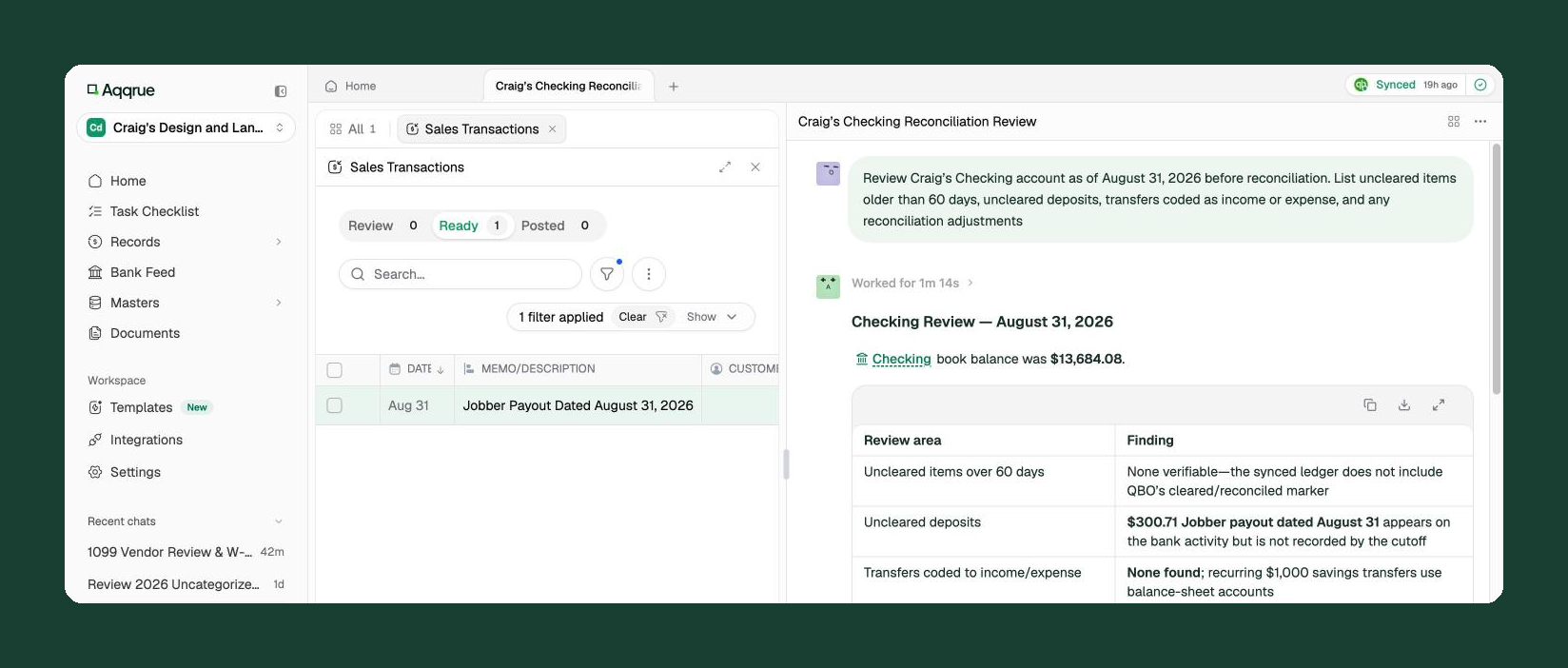
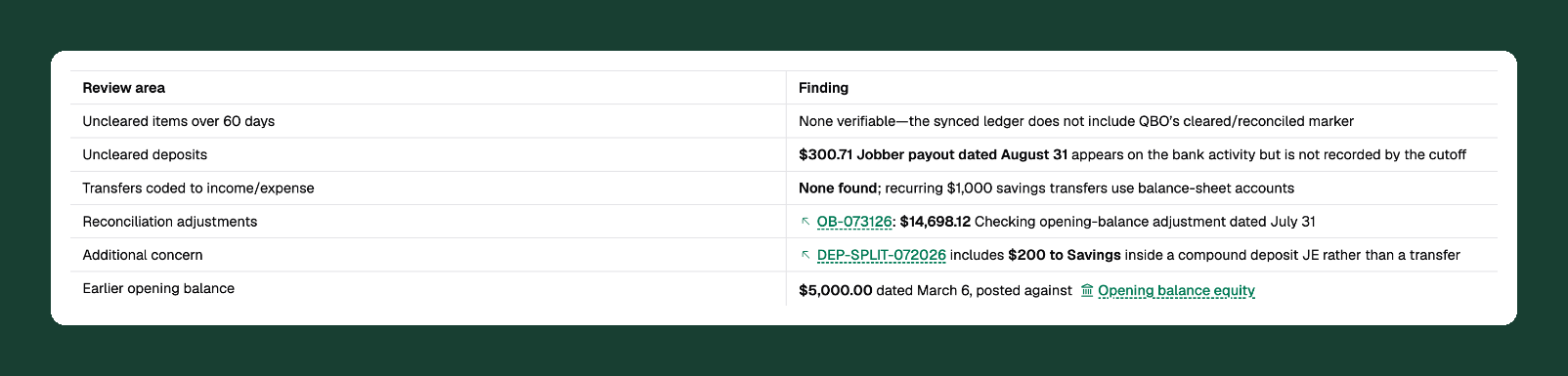
For a new hire, that changes the first few months. They review prepared reconciliations and entries, ask why something was coded a certain way, and learn your clients' patterns from real files. Aqqrue also learns from your firm's own past transactions for each client, so the recurring quirks your senior staff already handle show up in the prepared work.
The reviewer's judgment and the final sign-off stay with your team. Aqqrue simply means a new bookkeeper's early months are spent learning to review, which is the skill that matters most at a busy firm.
See how Aqqrue turns your SOPs into client-specific workflows.